How I Prep Math Centers in Under 5 Minutes Each Week
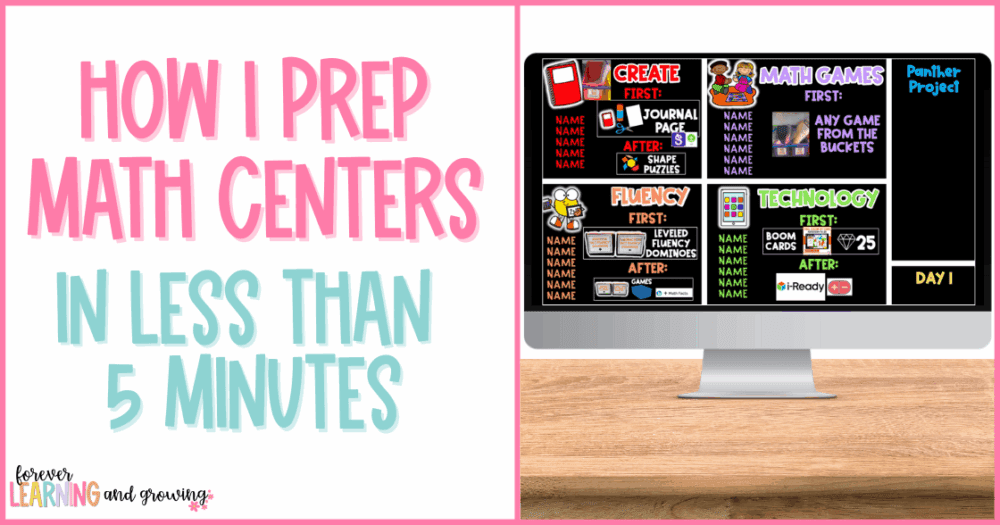
Let me paint you a picture: It’s Sunday evening, you’re in comfy clothes on the couch watching tv, and you suddenly remember you need to prep math centers for the entire week.
Old me would have panicked if I still had to prep math centers. I used to spend hours frantically searching Pinterest for “engaging math center ideas,” printing colorful activities that required intricate cutting and rounding up different math manipulatives, and staying up way too late cutting and laminating pieces for the activities.
Now: it takes me less than 5 minutes to prep math centers for the week. No joke.
The Shift That Changed How I Prep Math Centers
Here’s what I learned after years of over-complicating how I prep math centers: my students didn’t need something new and exciting every single week. Honestly it made it way harder for them– they would have to learn new games and rules and when they forgot, they would come interrupt me in small group. The time I was spending each week going over new “exciting” games took away from the time they could be actually doing the centers.
Instead, what students needed was consistency, clear expectations, and activities they could dive into without spending half the center time figuring out new rules.The moment I stopped trying to reinvent the wheel every week was the moment my math centers actually started working.
That’s when I realized: predictability isn’t boring for kids- it’s freeing.
My “Set It and Mostly Forget It” System to Prep Math Centers
My motto with centers has become KISS: Keep It Simple, Silly. By really streamlining my centers and having an explicit centers PowerPoint that hardly changes, I’ve been able to simplify math centers and not stress about them each week. I’ll explain in detail how my 4 centers work and what I’ve streamlined over the years. Your centers may look different than mine, but just make sure you can simplify each center as much as possible to make it easier on yourself– think routines & familiar activities. Let me explain the two key parts of my system that have really helped me prep for math centers in no time each week.
1. The PowerPoint That Hardly Changes
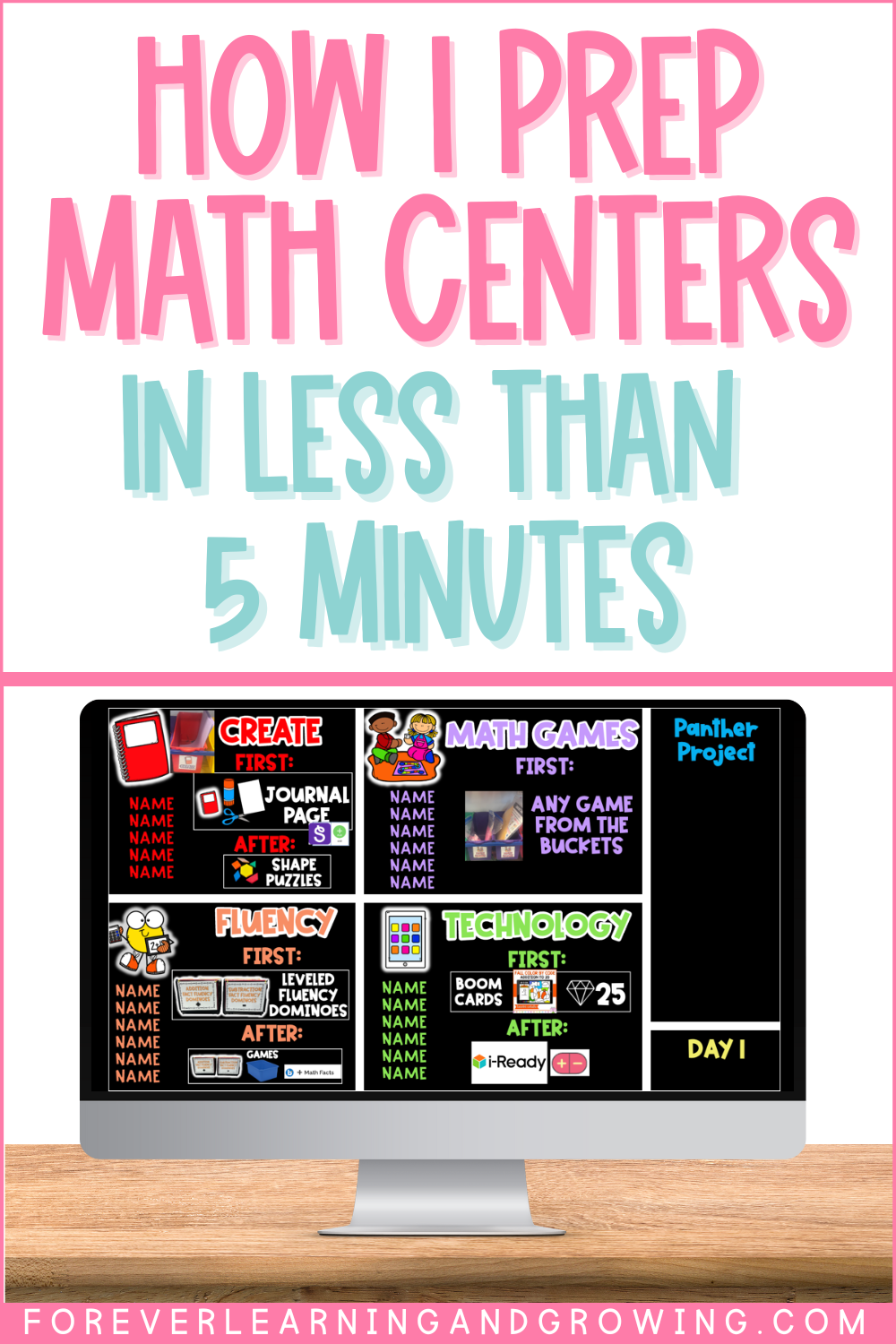
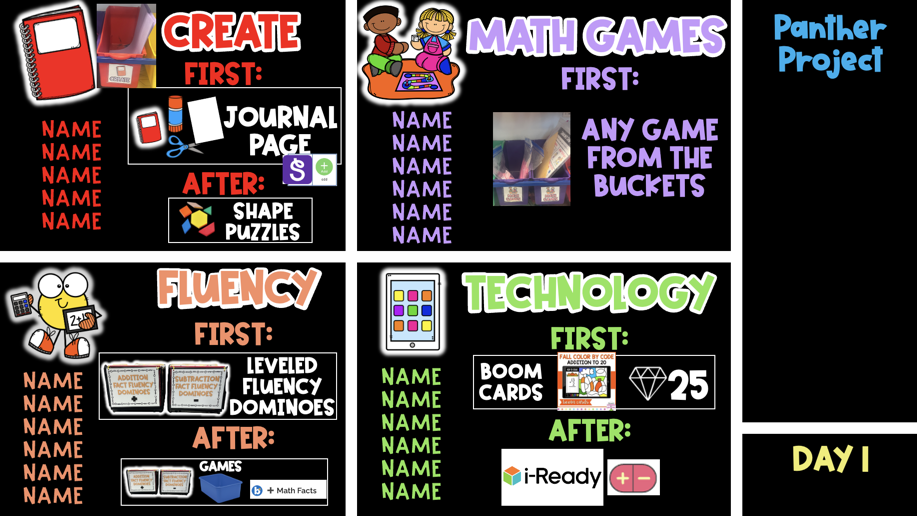
I have a math centers PowerPoint that has 4 slides for the center rotation for the week. Each day, the names under the center change depending on what they are supposed to do. So once you put all the names on each of the 4 slides, you’re done for the year (unless you change the groups up at any point).
The format stays exactly the same every single week- I use visuals from the classroom so students know exactly where to go to get materials. I even made sure to use a red journal so they know to glue it in their red journal! Students know exactly where to look, what to expect, and how to get started- I couldn’t be more explicit on most of these if I tried!
Literally the only thing I change on the PowerPoint each week when I prep math centers is the picture of the Boom Card deck they are supposed to do along with their goal for diamond points. All I have to do is go on Boom Cards, quickly assign the deck I want to do the next week, and then right click on the thumbnail to copy the image and paste it into my PowerPoint. For diamond points, it’s always set to getting 80% correct, so I can quickly see if a deck had 30 cards, I would set the goal as 25.
If I happen to have a group working on an enrichment project, I put their name under Panther Project and they know to work on the math enrichment project instead of centers.
Students LOVE this PowerPoint because everything they need is up there. The first few weeks of school I have to really train them to look at the board. Anytime they ask me what do I do or where do I get something, I point to the board and tell them to look at the visuals to help them. Even my emergent bilingual students can follow this because they know what their name looks like and can look at the visuals for support.
2. Activities that Are Simple and/or Last All Year
Let me break down each center and how I’ve streamlined the process:
Create Center
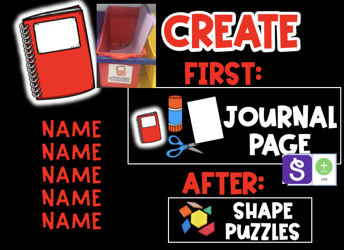
In this center, students start by doing a journal page on a skill they’ve already learned (I don’t want it to be a skill they’re learning just then because I want them to feel successful with the page and use it as spiral review). I ended up creating first grade math journal pages for the entire year, that I can now use year after year.
When I’m doing math plans for the week, I just pull up the file and print one journal page from either something we learned the week before or even earlier in the year. It’s super simple to even print 4 pages for the month at once. I then turn in the journal page to get copied along with our other math worksheets for the week. When it’s time to prep math centers for the next week, all I have to do is add the copied journal pages to the “create” bucket.
When students are done with their journal page, they take a picture on Seesaw and submit it to me. This is the accountability piece for me so I don’t have to collect their math journal pages up each time. If the journal page looks good, I delete it from my “to be reviewed” queue. If they had a hard time or made a mistake, I keep it in my queue as a reminder to call them to my back table when I get a chance to either have them fix the answer or go over a skill with them again.
Once students have submitted a picture of their completed journal page on Seesaw, they get to do pattern blocks creation challenges on the ground.
Fact Fluency
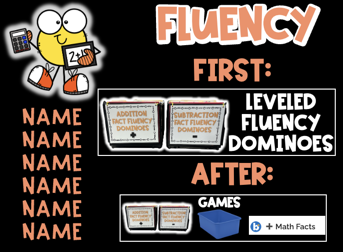
I love that once I teach this rotation, I never have to touch it again during the year! I use differentiated fact fluency dominoes in this station as the “must do” each week. Students find their “level” and complete the domino set. When they’re done, they have the choice to do another domino set on their level, play a fact fluency game I have in a blue bucket (that stays the same all year), or go on Boom Cards to do a deck on their corresponding “level” for math facts.
Math Games
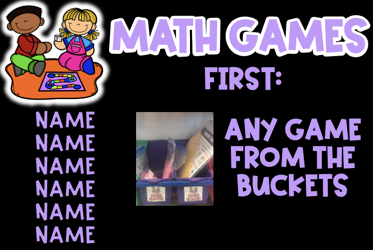
I used to change out the math games every week and honestly, it was exhausting! Now I tend to add a lot of fact fluency games in there that can stay all year long (because in first grade fact fluency is huge!!) At the very beginning of the year we learn how to play these games stay in rotation pretty much all year.
Every once in a while, I’ll add in a game I have to spiral review a certain concept. Match-ups are a favorite because they don’t really need to be explained. I also have dominoes for lots of skills, such as place value, telling time, and counting coins, that students already know how to play. I keep all my center games stored in two tubs in the back of my classroom, so whenever I want to add in something a little different I can easily go to the “place value to 99” folder in my tub and grab an activity or two to put in.
Technology
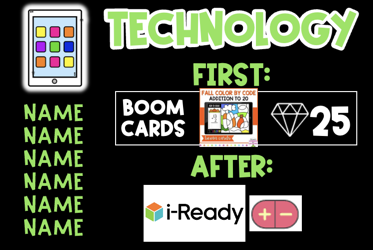
I have multiple Boom Card decks for pretty much every unit we teach, along with seasonal decks for fact fluency practice. Each week I quickly pick out a Boom Card deck to use that either reviews the skill from the week before or spiral reviews an older concept we have learned. It’s so easy on the PowerPoint to just change out the picture it shows, and the picture serves as a great visual for students so they can access the appropriate assigned Boom Card deck.
The best part about Boom Cards is there’s no cutting or prep work involved (besides literally clicking the “assign” button on Boom Cards). Most decks also have audio support so students can listen to the directions instead of asking me.
If students finish with Boom Cards and either meet or surpass their diamond point goal, they can get on iReady Math in my classroom. In the past, I would have them work on the corresponding IXL skill or their skill plan, but our district doesn’t have IXL anymore (so you could change that to be whatever resource you have in your district!)
How I Prep Math Centers: My 2 Weekly Tasks
- First Grade Math Journal Pages for the Create Station
- Like I said before, this is easy to prep for me because I use my already-created first grade math journal pages for this center. I usually like to prep a month at a time, which literally takes a few minutes because I just print 4 pages and turn in the copy slip for our amazing office clerk to copy off during the week for me. Then when it comes time to actually prep math centers for the next week, all I have to do is take the stack of copied journal pages and place it in the red bucket in my classroom.
- Tweak the Math Center PowerPoint
- Literally, all I have to do to prep math centers is change is the Technology portion. I go on my Boom account and assign a deck to review either last week’s concept or another previously taught skill. It only takes a few seconds to assign, and then all I do is copy/paste the thumbnail image of that deck into my PowerPoint and change number for the diamond point goal.
The Real Benefits of This Simplified System to Prep Math Centers
For Students:
- Clear expectations reduce anxiety
- More time spent on actual skill practice
- Opportunity to show growth within familiar formats
- Independence that builds confidence
For Me:
- Minimal weekly prep time (that’s easy to prep last minute if you forgot!)
- Consistent data collection (I love that I can look at reports on Boom Cards to see how my students do)
- Less behavior management (students know what to do)
- More energy for where it matters (small group instruction)
Making It Work in Your Classroom
If you’re ready to simplify your prep for math centers, start small:
- Pick a few center formats that works and stick with it. Whether it’s dominoes, matching games, or task cards- master one format before adding variety.
- Create a master PowerPoint or display that you can reuse. Change the content, keep the format consistent.
- Invest time upfront in activities you can use all year. Yes, it takes longer initially, but that one-time investment pays off for years.
- Embrace the power of “boring.” Your students will thank you for predictability, and you’ll thank yourself for those stress-free Sunday nights.
The Bottom Line
Sometimes the best teaching strategy is the simplest one. My students are getting more meaningful math practice than ever before, I’m spending way less time on prep, and Sunday nights are actually relaxing again.
Turns out, the secret to successful math centers isn’t novelty- it’s consistency, quality activities, and giving students the predictability they need to dive deep into learning.

Looking to use some resources mentioned in this post? Be sure to check out:
- Math Fact Fluency Dominoes for Addition and Subtraction to 20 (differentiated & last all year!)
- First Grade Journal Pages (this bundle lasts the entire year with lots of journal page options for every unit)
- Boom Cards (be sure to search on my page for whatever skill you’re looking for)
Want to save this pin for later?