Differentiated Fact Fluency Dominoes You Can Use All Year Long
I’m not exaggerating when I say adding fact fluency dominoes to my math centers has been one of the best decisions I made. A truly differentiated fact fluency that meets every student at their level? Yes please! But let’s look at how I even got there…
Picture this: You’re looking for a good fact fluency activity for your students but a month into school you’ve got a few kids who can add math facts to 10 in a flash, a few other kids who are still counting on their fingers for 3+1, and about fifteen kids scattered everywhere in between. If this sounds familiar, you’re not alone.
It can seem impossible to meet every student exactly where they are with one single resource. Many teachers struggle with creating truly differentiated math centers that work for every learner without requiring hours of preparation each week. Most “differentiated” activities end up being easier or harder worksheets rather than the engaging, hands-on learning our students need.
After years of trial and error and changing up my math centers countless times, I landed on dominoes in my fact fluency center that completely transformed my approach to differentiated math centers. I created the fact fluency dominoes to go along with our fact fluency system we use all year. This one simple change created a sustainable system I now use successfully all year long (and have for years now!)
Why Fact Fluency Dominoes Work for Every Student
These fact fluency dominoes are naturally differentiated because each set focuses on one specific skill level (ex. adding 2, subtracting 5). Instead of modifying activities for different learners, students work with domino sets that match exactly where they are in their math fact development.
Beginning learners can work on subitizing dominoes, building crucial visual number sense. They can practice recognize ten frame representations, tallies, dominoes, and fingers. On-level students work through systematic addition levels like adding 1, adding 2, and so on, with dominoes targeting exactly the facts they need to master. Advanced learners tackle mixed addition or subtraction dominoes that provide appropriate challenge without requiring additional planning.
The beauty of this fact fluency activity is that everyone feels successful because they’re working at their perfect level of challenge.
How the Fact Fluency Dominoes System Works in Practice
The implementation is surprisingly straightforward. I have a fact fluency station and the “must do” for this station is always the fact fluency dominoes. In my classroom, I start everyone off with subitizing dominoes to start the year. We then take a fact fluency timed test on Fridays. If they pass, they move up to the next level (adding 0). If they don’t pass, they keep practicing with the subitizing dominoes the next week. (If you want, you can read more about my fact fluency timed tests and how I track students’ progress).
Naturally kids will scatter in levels from there, with some students advancing every week and others needing a week or two extra practice on some levels. So when students demonstrate mastery of their current level through weekly assessments, they simply advance to the next domino set. No complicated planning required on my part.
My fact fluency dominoes have at least 3 different sets per level (for example, adding 2 has three unique sets of dominoes) so that there’s multiple sets for students to practice with. If you have more than one student on the same level at the fact fluency domino station, they can each grab their own set. I also love that a student can practice with all three sets because they all provide unique practice for them on their own level.
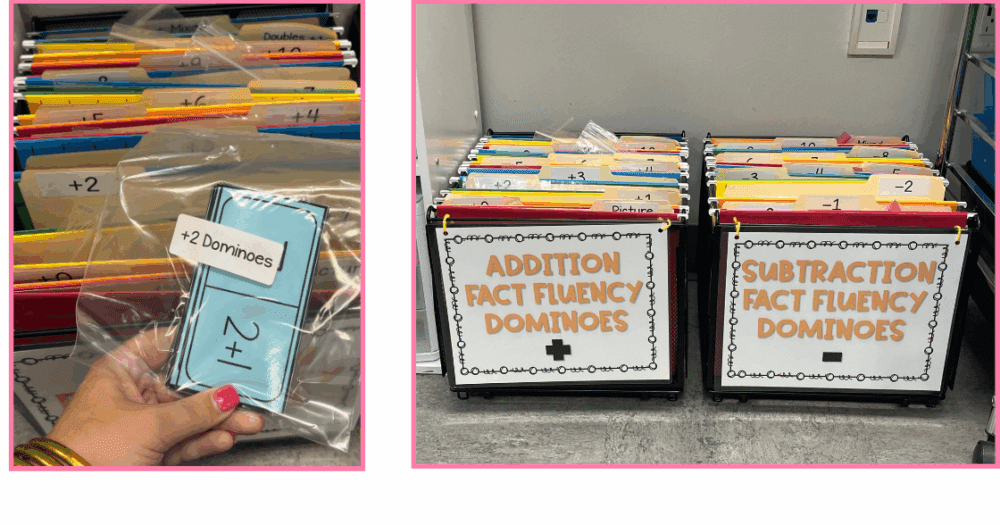
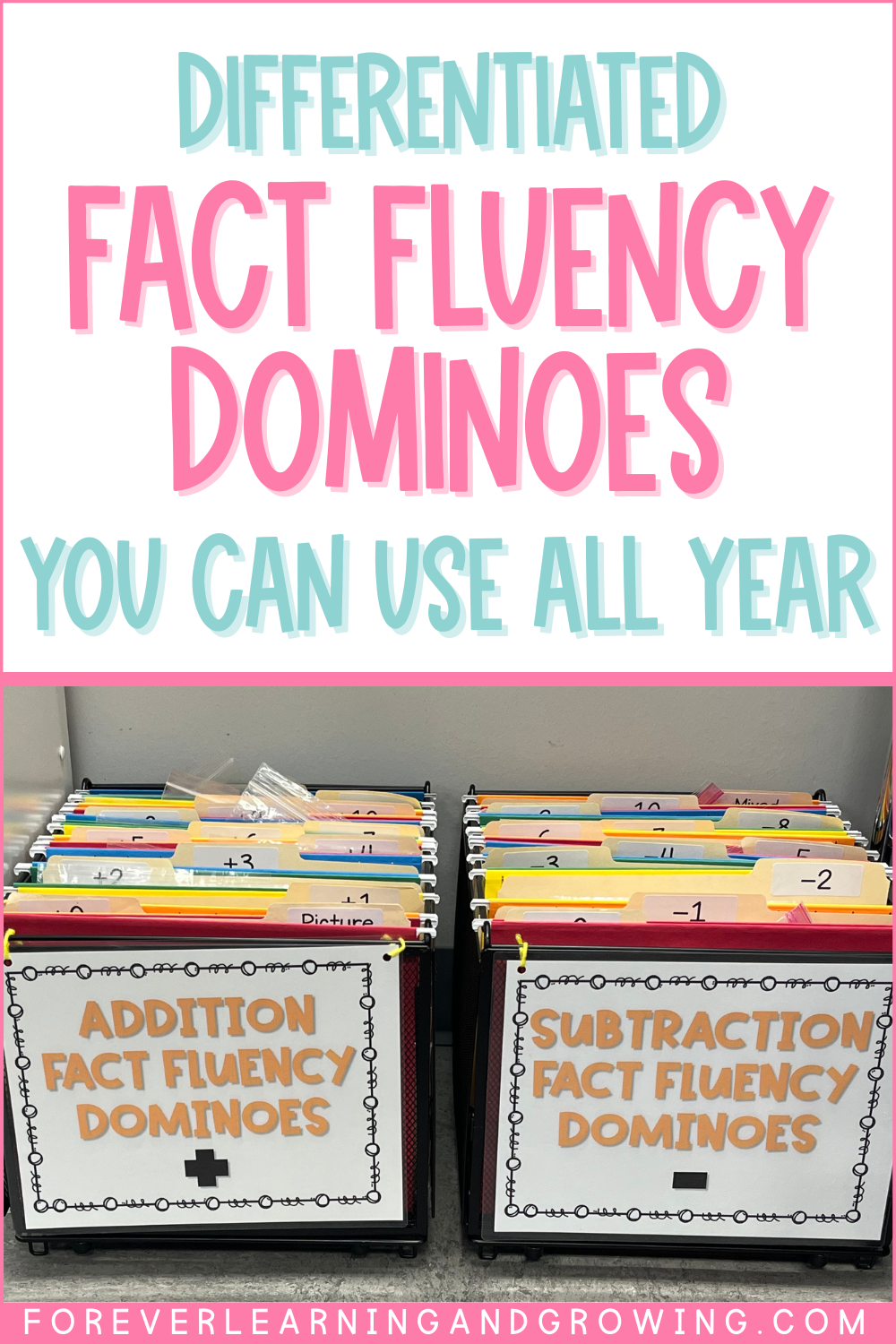
I organize all my fact fluency dominoes in two ctates (one for addition and one for subtraction). I use labeled file folders to organize the different domino sets. Each domino set is in a labeled baggie, and I even mark the level on the back of each domino in case it’s ever left on the ground.
How Students Use the Fact Fluency Dominoes
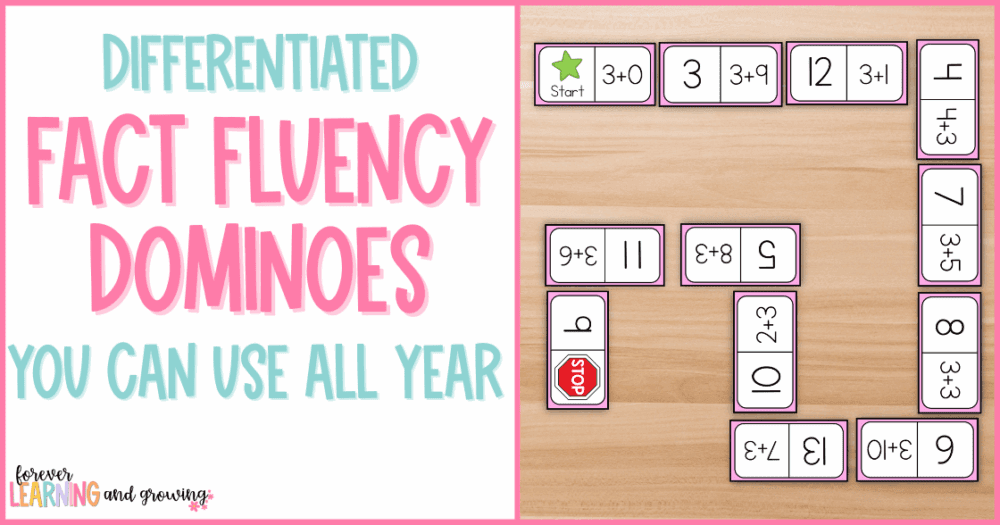
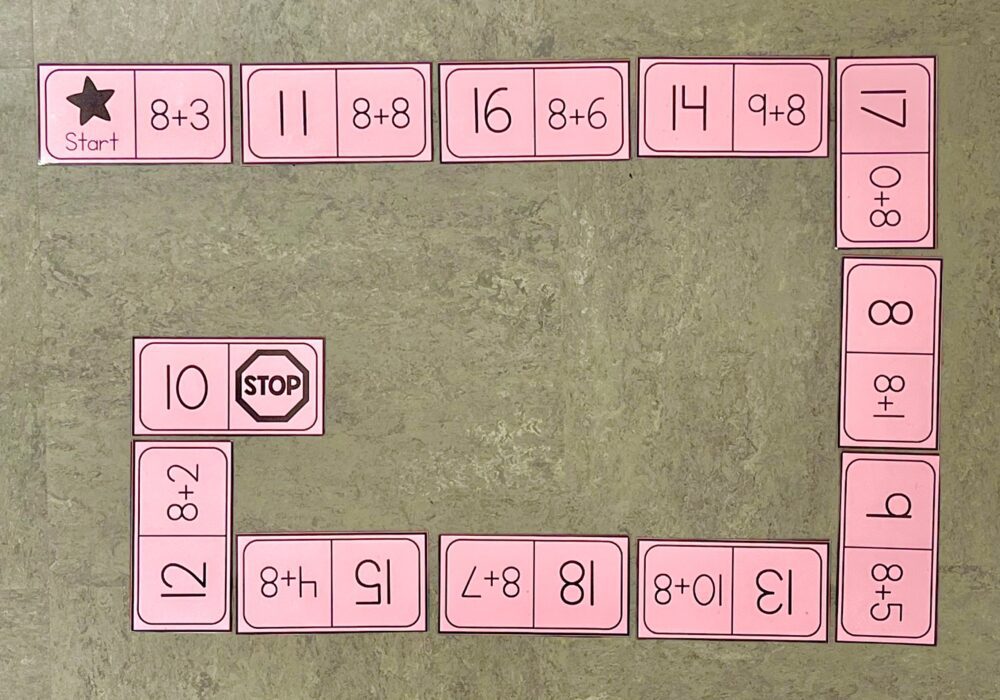
Students each have a “level” that they are on and supposed to be practicing. When they are at the fact fluency center, they go and grab the domino set at the corresponding level and then find a spot on the ground to do them. Each domino set comes with 12 dominoes. There is a “start” domino that has a star and a “stop” domino with a stop sign.
Students learn that the domino with the star is the one they always start with. Beside the star on the other domino will be a math fact, such as 3+2. They then need to find the domino that has the answer on it, in this case 5. They keep matching dominoes up (they answer can be placed above, below, or to the side of the fact they are answering) until they get to the “stop” domino.
I always tell my students that if they have any extra domino cards leftover at the end, it means they messed up somewhere. When students are done, I have them clean up and put it back in the baggie and correct spot in the crate. If you wanted more of an accountability piece, you could have students take a picture of their completed domino set and submit it on Seesaw or whatever platform you use with students.
The 32-Level Progression That Sustains Itself
What makes this system truly sustainable is its logical progression. The 32 levels build systematically on each other, eliminating guesswork about what comes next.
The addition progression begins with subitizing to build number sense, then moves through adding 0 through adding 10 one concept at a time. Students then practice doubles and doubles plus one before moving to mixed practice that combines everything they’ve learned.
The subtraction progression follows a similar systematic approach, building on addition knowledge students have already mastered. This strategic practice connects new learning to existing understanding, making the progression feel natural and achievable. Students advance at their individual pace while I always know exactly what comes next for each child.
The Time-Saving Reality
Before implementing this system, math center planning consumed hours each week. I constantly created different worksheets for various levels, cut out and laminated countless centers to rotate through, and felt guilty when some students were bored while others struggled.
A few years ago when I first designed this system, I prepped the domino sets once. I’ve used the same sets for years since and have never had to prep a thing for them since! I love that they can be used year after year with my classes and that with so many sets, the fact fluency dominoes truly are utilized the entire year in math centers!
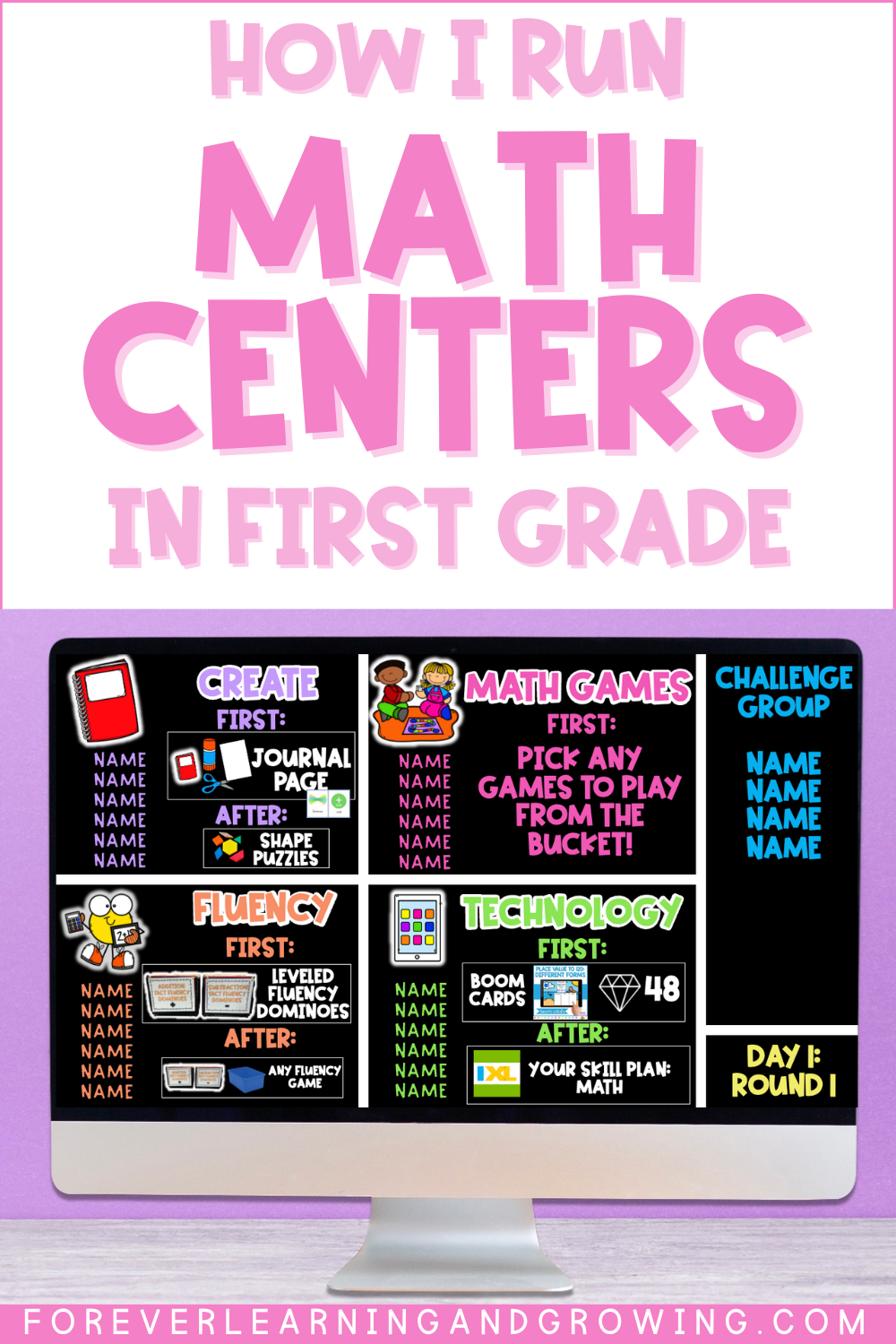
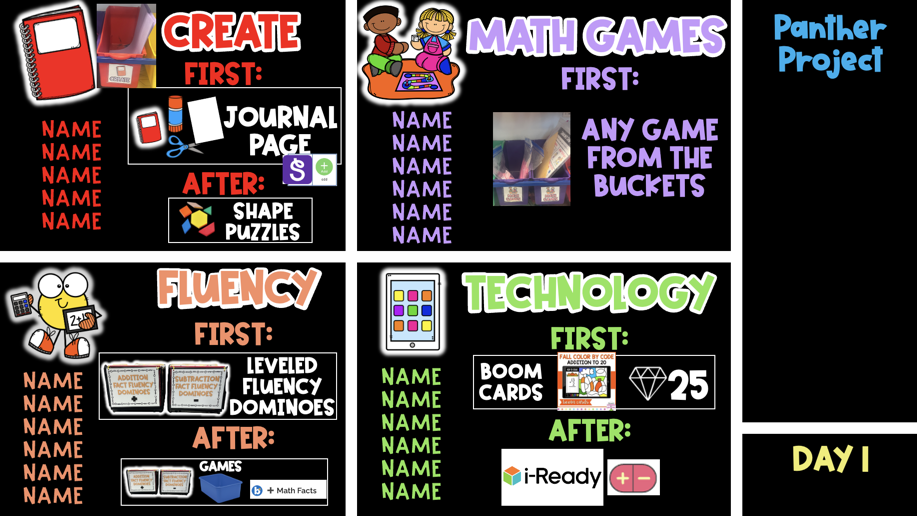
Now my weekly math center preparation literally takes about 3 minutes (I have a few games in one station that I don’t change out too often, I pick a journal page for additional practice/spiral review in another station, and I assign a relevant Boom Card deck in my technology station). The fact fluency domino system essentially runs itself, freeing me to provide targeted support where needed rather than managing multiple complicated activities.
The Foundation for Success
The key difference between this approach and random domino games is the systematic progression. While fun activities have their place, building true fluency requires targeted, sequential practice where every minute of center time moves students forward in their mathematical development.
Students practice their appropriate levels and then track their progress as they advance through the system. The structure is designed for simplicity and student independence.
Year-Long Impact
After a few weeks of practice and guidance from me, students are able to independently grab their correct domino level each week, practice without constant direction, demonstrate confidence in their mathematical abilities, and often request additional fact practice opportunities (that’s why I created Boom Cards to go along with the systematic progression!)
For teachers, this translates to predictable, effective math centers that work consistently throughout the entire school year. No more last-minute activity creation or differentiation guilt, just reliable, systematic practice that meets every learner’s needs.
When you have a system that truly differentiates itself, teaching becomes significantly more manageable. No more scouring for new ideas each week. Students receive exactly what they need to grow, and teachers regain valuable time and energy for other important instructional priorities.
The systematic fact fluency domino approach proves that effective differentiation doesn’t have to be complicated. Sometimes the most powerful solutions are simple, sustainable, and successful for everyone involved.

Want to save this pin for later?